
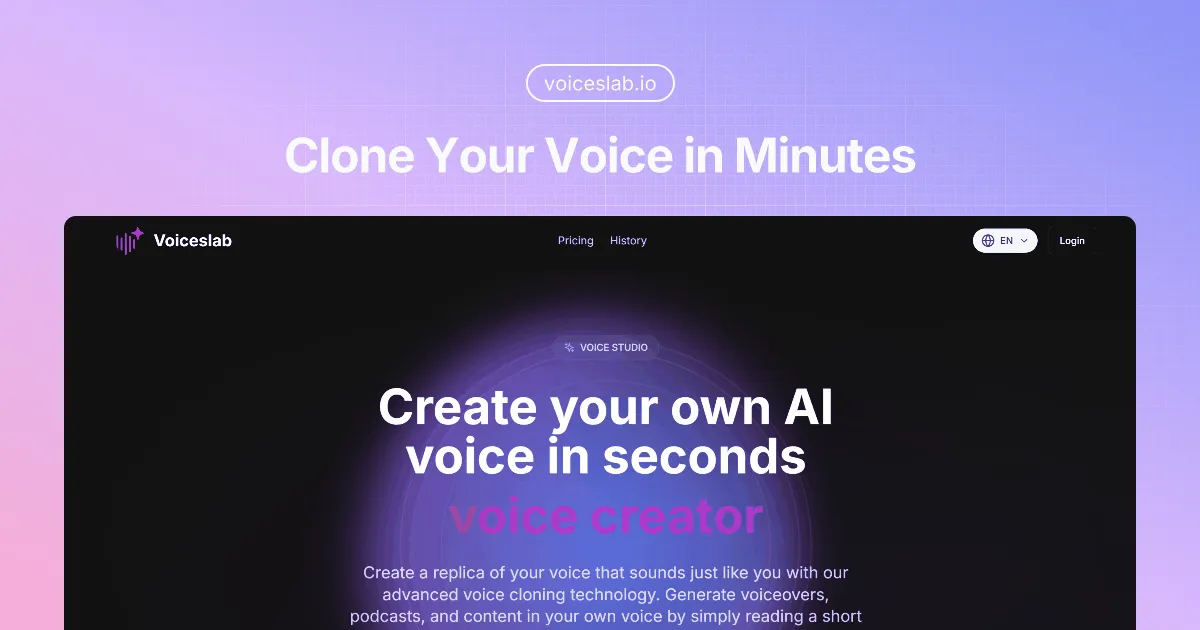
Overview
Voiceslab is a browser-based AI voice cloning platform built for podcasters, video creators, marketers, and internal communications teams. A recording of 10–60 seconds is sufficient to produce a reusable digital voice that keeps the speaker's tone, accent, and cadence. The cloning engine sits beside related utilities — text-to-speech, an AI dialogue generator, and PDF-to-audio conversion — inside a single dashboard. Paid pricing tiers and enterprise terms are not itemized on the landing page.
Key Features
- Short-sample cloning: a 10–60 second clip of clean speech is analyzed and turned into a persistent voice profile reused for later generations.
- 24-language coverage: Arabic, Cantonese, Chinese, Czech, Dutch, English, Finnish, French, German, Greek, Hindi, Indonesian, Italian, Japanese, Korean, Polish, Portuguese, Romanian, Russian, Spanish, Thai, Turkish, Ukrainian, and Vietnamese.
- No-signup preview: a text field accepts up to 500 characters per request and grants three trial generations before an account exists.
- 0.5-second latency target: the vendor positions the synthesis engine for live and real-time application scenarios.
- Security statements: end-to-end encryption and SOC 2 compliance are claimed on the site; third-party audit reports are not published.
- Tiered access: a free account includes one voice clone and 3,000 characters with no card required, while paid plans raise both quotas.
- Generation ceiling: outputs cap at 10,000 characters per request, and pauses or speech rate cannot be tuned directly for cloned voices.
Use Cases
- Audiobook and podcast production where narration must remain in the author's voice and episode updates should avoid repeat studio sessions.
- Video advertising and product announcements that need fast voiceover turnaround in a recognizable brand voice.
- Corporate messaging, training modules, and leadership updates distributed consistently across global teams.
- Localization work: creators publish in languages they do not speak while retaining a familiar vocal identity.
- Customer support and e-learning content that benefits from a human-sounding presenter instead of a generic library voice.