
Overview
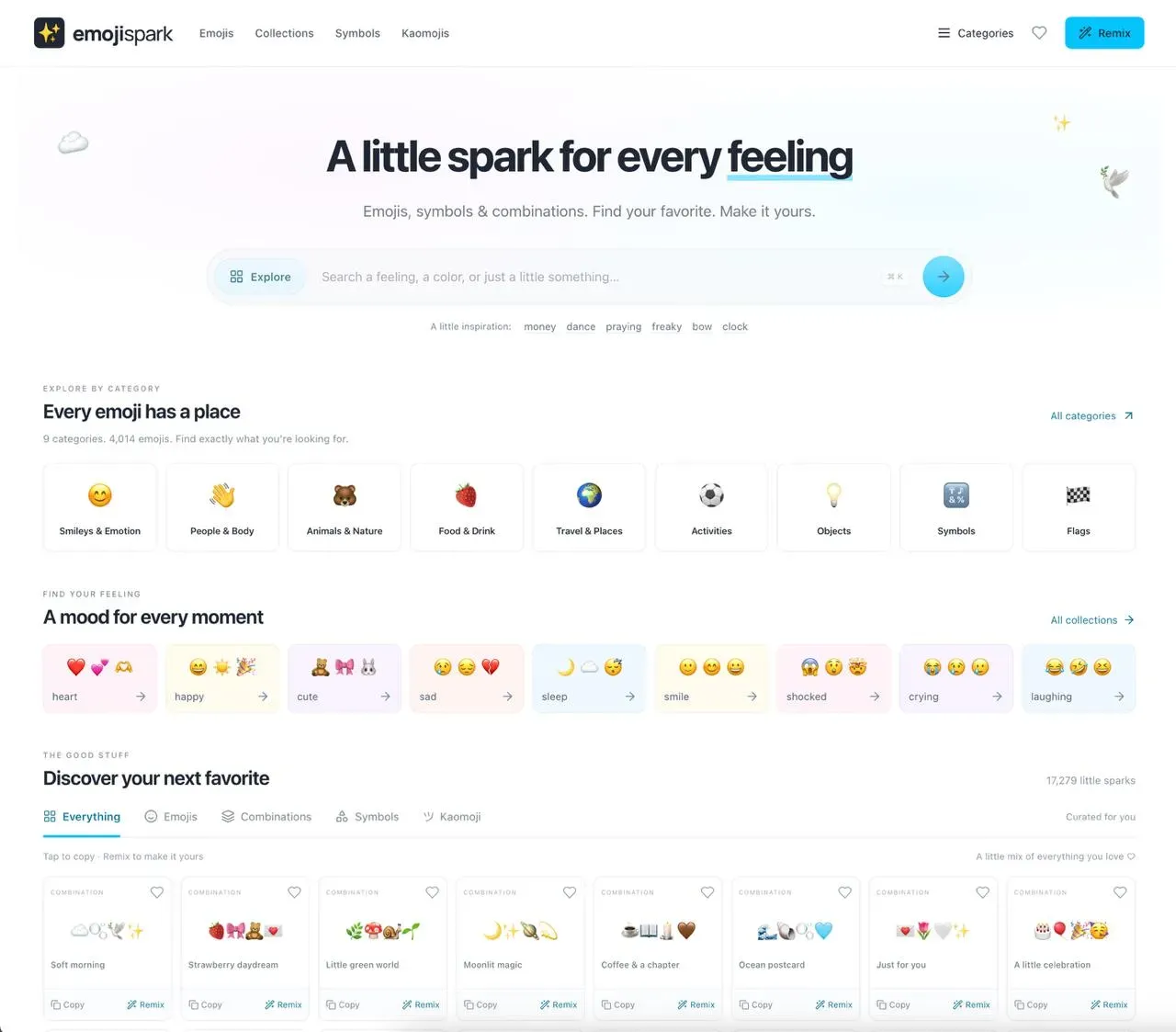
EmojiSpark is a browser-based catalog of emojis, text symbols, kaomoji, and curated multi-character combinations. It indexes 4,014 emoji entries across nine top-level groups and layers mood-based collection pages on top of that index. A built-in generator assembles several characters into a named, reusable string. Searching and copying need no account, and bookmarked items collect in a personal list. Pricing is not disclosed on the homepage.
Key Features
- Faceted catalog — nine top-level categories, each carrying its own filter set; counts include skin-tone and variant forms.
- Cross-type search — a single query runs against emojis, combinations, symbols, and kaomoji, then gets narrowed with Everything / Emojis / Combinations / Symbols / Kaomoji tabs.
- Combo Studio — every card exposes a Remix link that passes the character string to the generator as a seed parameter, so an existing combination becomes the starting canvas instead of a blank one.
- Copy and save controls — two actions per card; the saved list is reachable from the header and can be cleared in one step.
- Mood landing pages — short slugs such as /heart, /happy, /cute, /sleep, and /crying return a pre-filtered set rather than forcing manual browsing.
- Standalone utilities — a Heart Sticker Maker, ASCII Heart Text Art, and a Moon Phase Emoji page sit beside the main catalog.
- Locale switching — English, Spanish, and French variants, declared through hreflang alternates on the root document.
- Community submissions — a dialog takes a combination, a name, and comma-separated tags, capped at 100 characters, with manual review before publication.
Use Cases
Social media and community managers pull decorative glyph sets for captions, bios, and status lines without leaving the page. Designers and copywriters prototyping micro-typography get dividers, ornaments, and lettering variants from the symbol index. Chat and forum users assembling nickname strings benefit from the copy action and the saved list, which carries a shortlist across sessions. Writers working in plain-text channels lift ASCII art from the dedicated utility pages. No public API or bulk export is documented.