
Overview
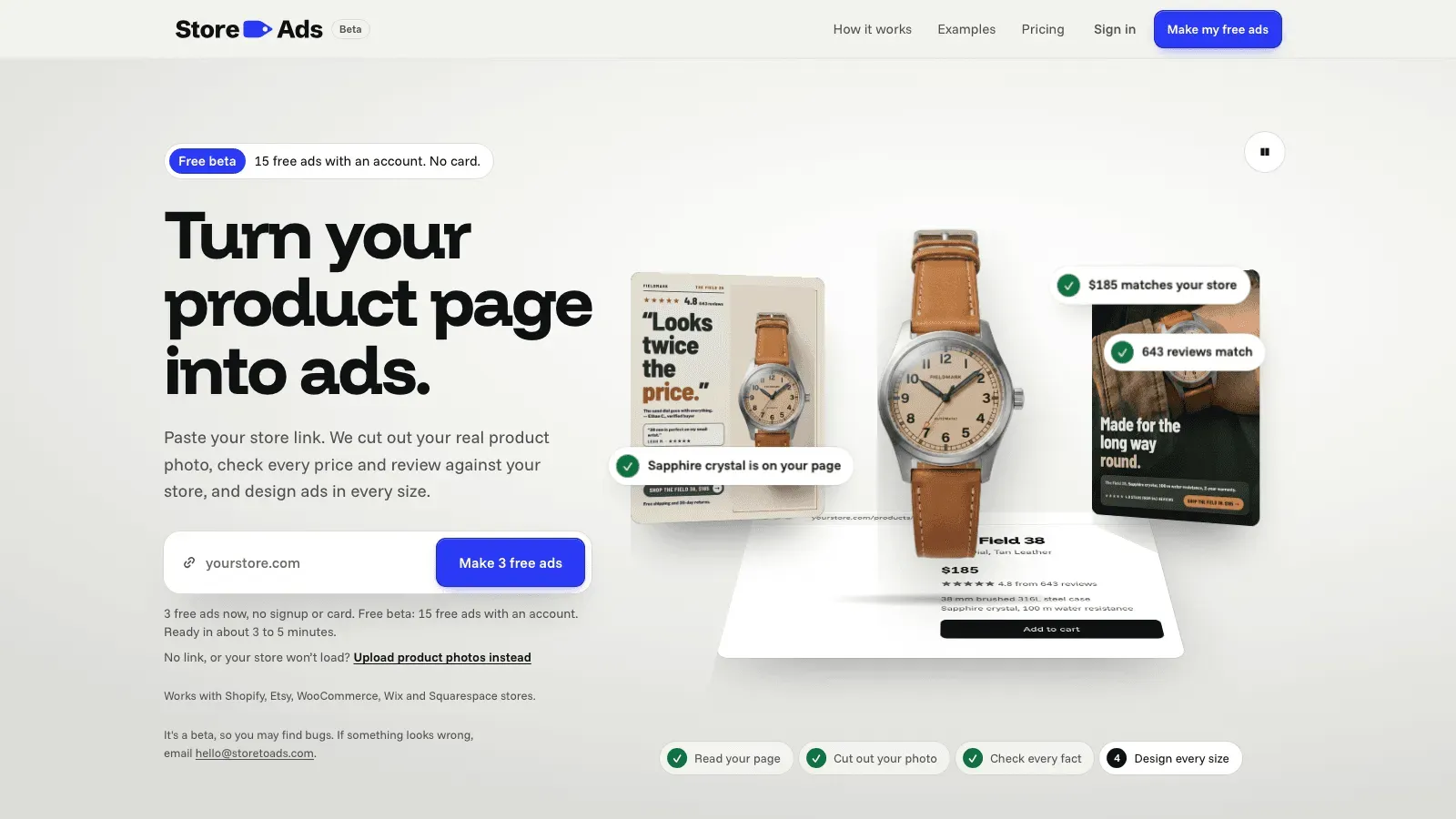
StoreToAds is a web application that turns an e-commerce product page into a batch of static ad creatives. A merchant submits a store URL, and the platform extracts the product photo, pricing and review data before composing layouts around that original image rather than generating new product pixels. It targets independent and mid-market merchants on Shopify, Etsy, WooCommerce, Wix, Squarespace, PrestaShop or Amazon who need campaign-ready assets without a design team. The service is currently in beta.
Key Features
- Store-link ingestion — a single URL field accepts a storefront or an individual listing; the parser collects products, sale prices and review counts automatically.
- Non-generative product imagery — the original photo is cut out and composited into each layout, so packaging and labels stay legible instead of being redrawn by a model.
- Source-checked copy — every price, review figure and claim printed in an ad is compared against the merchant's own page, and unmatched statements are stripped before delivery.
- Five simultaneous formats — paid designs export at feed (4:5), story (9:16), square (1:1), Pinterest (2:3) and Google (1.91:1). Free previews are feed-only.
- Editable text layer — headlines, prices, badges and buttons can be rewritten in the browser at no charge.
- On-demand or scheduled output — ads are produced ad hoc or delivered in weekly batches depending on the plan.
- Paused Meta handoff — designs can be pushed to Facebook as paused ads, so nothing spends until the advertiser activates them.
- Manual fallback path — storefronts that block automated crawling can be handled via uploaded page screenshots or hand-entered product details.
- Chat-based creation — a separate integration produces ads inside Claude and ChatGPT.
- Tiered pricing — free beta at $0 with 15 ads, Lite at $29/month for 9 ads, and Starter at $49/month for 20 ads with logo and colour application; Growth, Pro and Scale at $99, $149 and $199 add larger batches and Meta delivery. Turnaround is quoted at roughly three to five minutes.
Use Cases
Small storefronts without in-house design capacity are the clearest fit: the workflow replaces a photo-editing session with a URL paste and a product checkbox. Performance marketers running multiple placements benefit from the single-design-to-five-ratios export, since one input covers feed, story, square, Pinterest and Google slots without separate resizing passes. Merchants in regulated or claim-sensitive niches — supplements, skincare, jewellery — get value from the verification layer, which removes prices and review quotes that cannot be traced back to the source page. Agencies producing routine creative refreshes for several clients can use scheduled delivery to keep a steady output cadence. Teams already running Meta Advantage+ or Shopify Campaign Autopilot can treat the tool as an asset feeder rather than a replacement. Stores that block crawling still have a path through manual upload, though that step reintroduces some of the manual labour the product is designed to remove.