
Overview
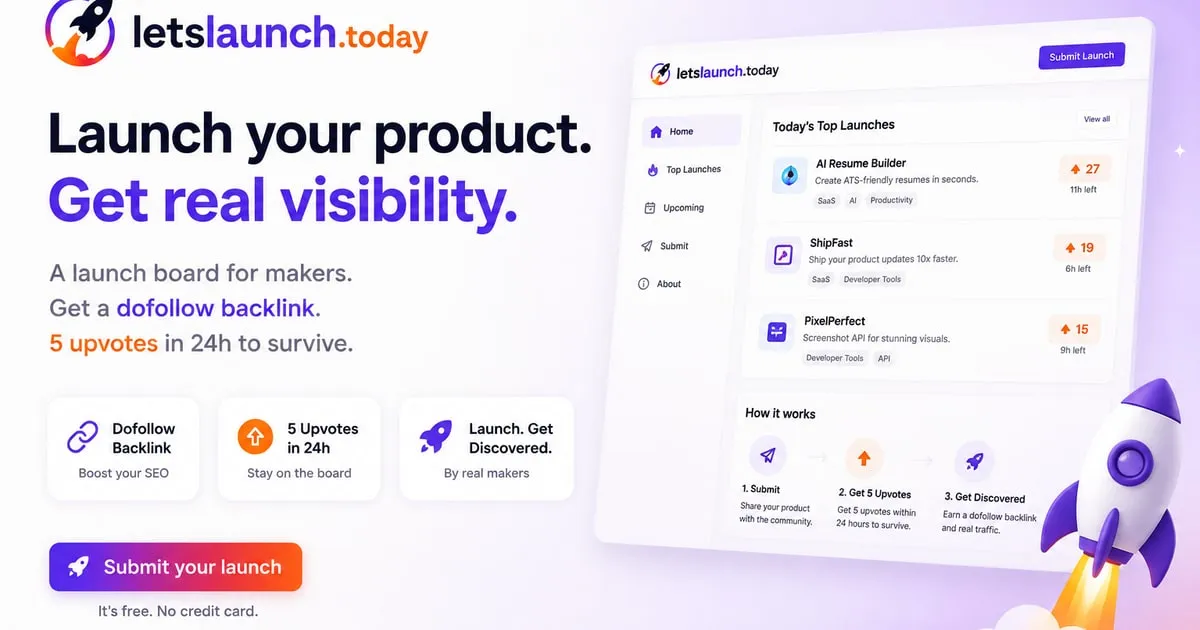
indieshipped is a curated launch platform and directory built for indie hackers who ship software and content products on the open web. The site operates on a fixed weekly cadence: new submissions are published together in a single drop that lands every Monday, and each entry gets a dedicated project page designed to rank in search results. The audience is primarily solo founders, bootstrapped product teams, and small makers who need a first wave of qualified traffic without paying for a large ad budget. Listings are lightweight — a name, a one-paragraph pitch, category tags, an outbound link to the live product, and an upvote counter.
Key Features
- Weekly drop cycle — Submissions publish in batches rather than streaming in real time, which concentrates attention on a small set of products per week and gives each one a fairer share of front-page exposure.
- Upvote-driven ranking — Visitors can vote on any listing without an account gate visible in the browsing flow, and vote counts feed the ordering of the weekly board.
- SEO-oriented project pages — Every entry resolves to its own URL under
/projects/, with structured headings, a project description, category labels, and an outbound link carrying a UTM source parameter back to the maker's site. - In The Spotlight placements — Above the fold, three fixed slots are sold as paid promotion: two "Top Pick" cards for current featured products and one "Open Slot" reserved for a buyer.
- Shipping This Week board — A numbered list of the current week's submissions with thumbnail, tagline, category chips, an outbound visit link, and an upvote button per row.
- Archived leaderboards — Separate routes expose every launch, this week, this month, a trending view labeled "Heating up," and a hall of fame, giving older drops a second discovery surface.
- Category directory — Browsable taxonomy covering Productivity, Content, HR, Education, Mobile Apps, Health and more, each with a live listing count.
- Monday newsletter — A single weekly email summarizes the best new startups from the drop, with a subscription form in the sidebar and footer.
- Search and navigation conveniences — A header search field with a ⌘K shortcut, a keyboard-accessible menu sheet on mobile, theme toggling, and utility routes for alternatives, makers, and a randomized "Surprise me" discovery page.
- Submission flow — A dedicated
/projects/submitroute handles intake for makers, while/pricingdocuments advertising and affiliate options.
Use Cases
For makers preparing a public launch, the weekly format solves the cold-start problem: instead of publishing into silence, a product appears alongside a small cohort of peers with a shared traffic spike. Because project pages persist and are indexed, a listing continues to function as a backlink and a landing page long after the launch week ends. Marketers and product researchers can use the category directory and archived leaderboards to track which problem spaces indie developers are actively shipping into, week over week. Directory operators and advertisers get a transparent placement model through the spotlight slots. The main limitation is volume — with only a handful of shipped products and a small founder mailing list, the traffic ceiling is modest compared to larger aggregator platforms.