
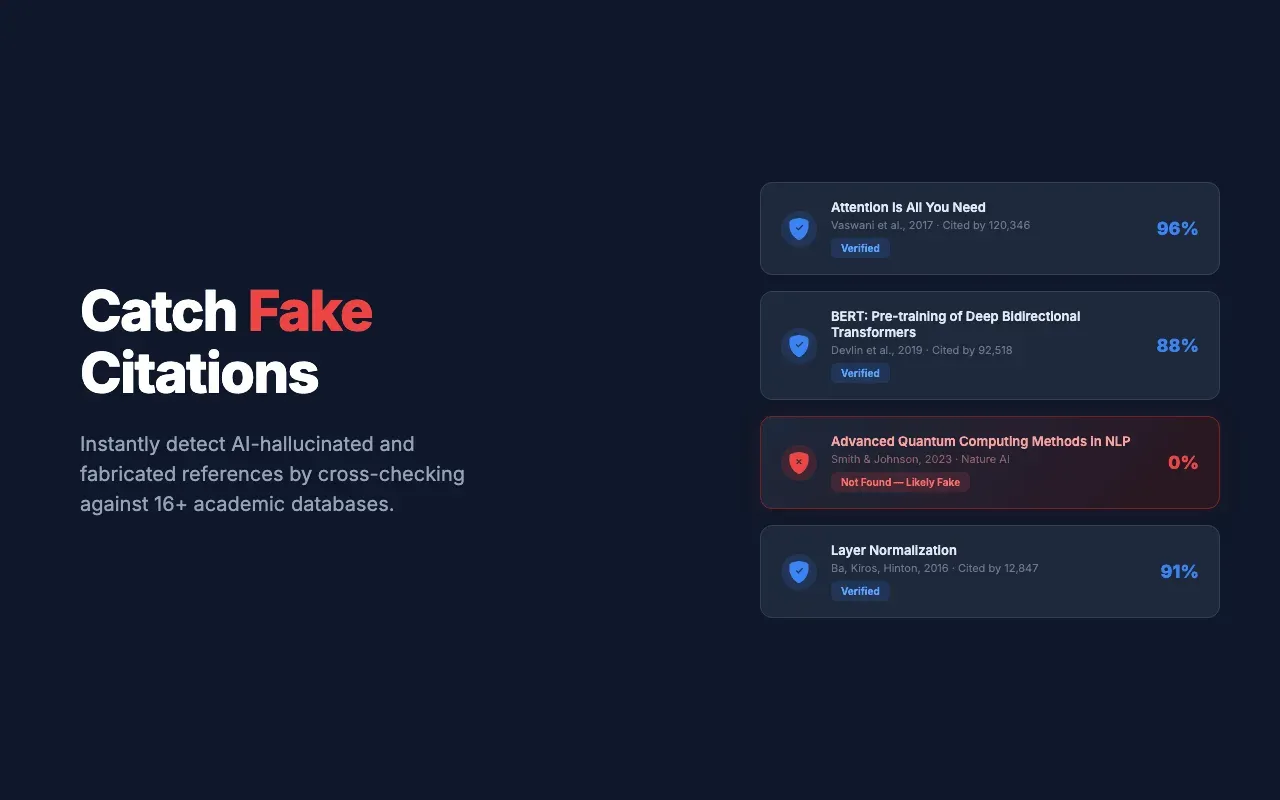
Overview
CiteTrue's Citation Checker is a free, AI-driven verification utility that validates reference lists against major academic databases. It targets students, researchers, editors, and reviewers who need to detect fabricated, mangled, or AI-hallucinated citations before submission, review, or publication.
How verification works
- Each entry is split into discrete fields: title, authors, year, DOI/identifier, venue, volume, and pages.
- Every field is compared separately against indexed records, so a citation can point at a real paper and still be flagged as wrong.
- Retrieval algorithms are paired with large language models to generate a confidence score per reference.
- Cross-referencing spans Crossref, OpenAlex, PubMed, arXiv, Semantic Scholar, IEEE, Springer, Wiley, Elsevier, ACM, and other registries.
Practical applications
- Manuscript preparation: batch-check dozens or hundreds of references in a single pass, with automatic input-format correction.
- Peer review: screen incoming submissions for bogus references during initial triage.
- Advising and teaching: instructors confirm student sourcing without manual lookups.
Evidence and positioning
- The tool cites peer-reviewed findings that a large share of GPT-generated bibliographies were fabricated outright, and that 2023 set a retraction record.
- A browser extension, Mac app, public API, and MCP server extend checking beyond the web interface.
- Access runs on a free daily quota, with credit-based deep verification and invite bonuses for heavier workloads.
- The interface ships in eleven locales, including French, German, Chinese, Japanese, and Arabic.