
Introduction
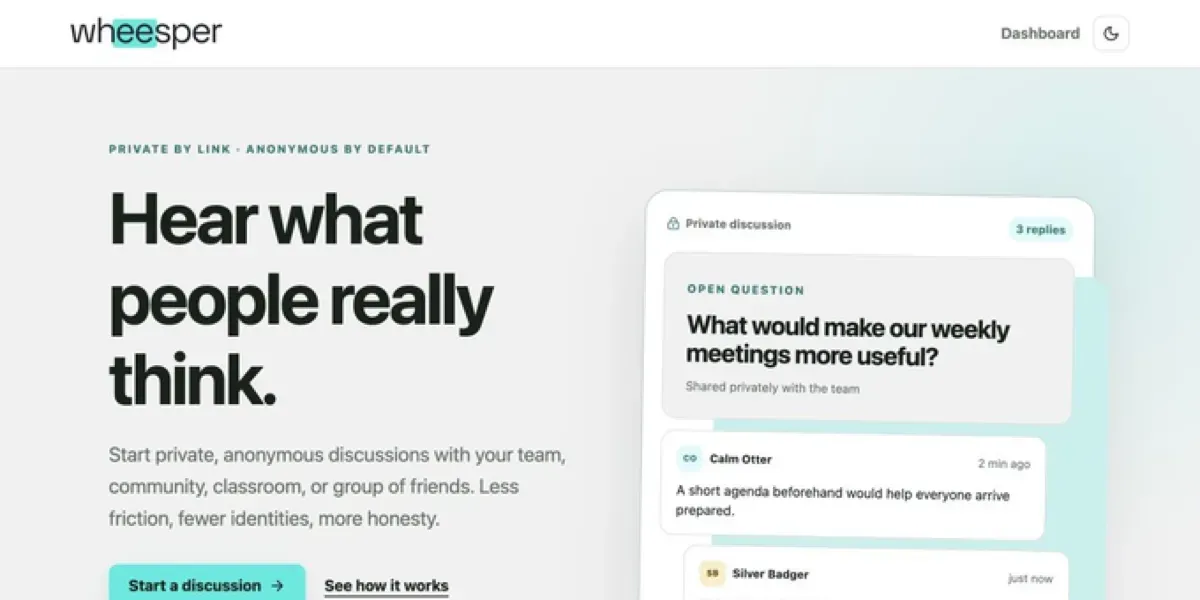
Wheesper is a privacy-focused discussion platform that eliminates the link between a user's identity and their contributions. Unlike forums or social media where usernames accumulate a traceable history, each Wheesper discussion is a self-contained environment with its own set of pseudonyms. The service targets teams, communities, educators, and creators who need candid feedback without the baggage of reputational risk. By default, discussions are not indexed by search engines and are only accessible via a unique, unguessable URL—making it a tool for honest, off-the-record conversations.
Key Features
Wheesper differentiates itself through several architectural decisions that prioritize anonymity and simplicity.
Private by Link Every discussion is created with a cryptographically random URL. There is no public directory or searchable index of conversations. The link serves as the sole key to entry, ensuring that only those with the link can read or participate. This model works similarly to private Slack channels or WhatsApp group invite links, but with stronger isolation.
Disposable Pseudonyms Upon entering a discussion, each participant is assigned a unique pseudonym—such as "QuietLlama42"—that is generated fresh for that specific room. This pseudonym is meaningless outside the context of that single discussion. Subsequent visits to other discussions generate entirely new pseudonyms, so there is no way to link a person's comments across different topics. This design directly addresses the problem of de-anonymization through posting history.
Threaded Replies The platform supports nested replies, allowing conversations to branch and remain organized. This is a critical feature for any discussion tool; linear comment threads quickly become unreadable when multiple topics emerge. Each reply is indented under its parent, making it easy to follow the flow.
Creator Controls The person who starts a discussion—the creator—has management capabilities. According to the FAQ (linked below), creators can delete the entire discussion or remove specific replies. This gives a safety valve if a conversation goes off the rails or sensitive information is shared.
No Account Required Participants do not need to register or log in. They simply click the link and start replying. This reduces friction and further protects anonymity because no email, name, or password is stored.
Lightweight Interface The UI is minimal: a header for navigation, a main content area for discussion, and a footer with links. No heavy JavaScript frameworks or analytics that could track users. The site also supports light/dark mode, which is a small but appreciated touch.
How It Works
Getting started with Wheesper takes under a minute. A visitor navigates to the start page, enters a topic question, and clicks "Start an anonymous discussion." The system generates a unique URL—something like wheesper.com/d/abc123xyz—and presents the creator with that link. The creator then shares the link via any channel (email, chat, private message, etc.).
When a recipient opens the link, Wheesper assigns them a pseudonym and reveals the discussion thread. They can type a reply or respond to an existing comment. No authentication is needed. The interface is essentially a single-page application that refreshes to show new messages.
Because there is no search history or public feed, the only way to discover a discussion is through the shared link. This makes Wheesper fundamentally different from platforms like Reddit or Twitter, where posts are discoverable by default.
The dashboard likely lists discussions that a user has started (using browser storage or a cookie, since there is no account). However, the website does not provide detailed documentation on the dashboard's functionality. The FAQ page clarifies that Wheesper does not store personal data beyond what is necessary to operate the session.
Use Cases
Wheesper’s design makes it suitable for several scenarios where anonymity is paramount.
Workplace Feedback Employees often hesitate to raise concerns about management, culture, or harassment. Wheesper allows a team lead or HR person to create a discussion link and share it with the team. Team members can respond with honest opinions without fear of reprisal. The disposable pseudonyms ensure that no one's comment history builds up.
Classroom Participation In educational settings, students may be shy or worried about peer judgment. An instructor can post a question and have students reply anonymously. This surfaces confusion or ideas that would otherwise remain unspoken.
Creative Critique Artists, writers, and musicians can share a work-in-progress with a link and receive unfiltered feedback. Critics are more likely to be blunt when their name is not attached.
Community Governance Online communities (e.g., open source projects, hobby groups) can use Wheesper to gather input on rules, events, or leadership changes without the noise of public forums.
Personal Group Decisions Friend groups planning a trip or sharing sensitive feelings can use a one-off discussion to make decisions without social pressure. The link can be deleted after the conversation wraps up.
Pricing & Value
As of the time of this review, Wheesper does not display any pricing page. The service appears to be free to use, with no limits on the number of discussions or replies. There is no mention of premium tiers, ads, or data monetization. This raises questions about long-term sustainability: how does the service fund its infrastructure? The privacy policy states that minimal data is collected, which is consistent with a privacy-first product. However, the lack of a business model may worry some adopters who need guaranteed uptime and support.
For individual users or small teams running ad-hoc discussions, the free offering is excellent value. For enterprise deployments, the absence of SLAs, SSO, or moderation tools may be a dealbreaker.
Final Verdict
Wheesper solves a genuine problem: the chilling effect that persistent identities have on honest conversation. Its implementation is clean and focused, with no bloat. The key strengths—link-based privacy, disposable pseudonyms, and no account friction—are executed well. The platform is immediately usable and requires zero onboarding.
However, the lack of pricing transparency and the missing features like media uploads, rich text formatting, or integration with tools like Slack limit its scope. It is best suited for short-lived, text-only discussions where trust and anonymity are more important than multimedia richness.
For teams that need a quick, anonymous feedback channel, Wheesper is a solid choice. It is not a replacement for full-featured collaboration platforms, but it excels at its narrow mission. If the service remains free and reliable, it could become a go-to tool for sensitive conversations.