
Introduction
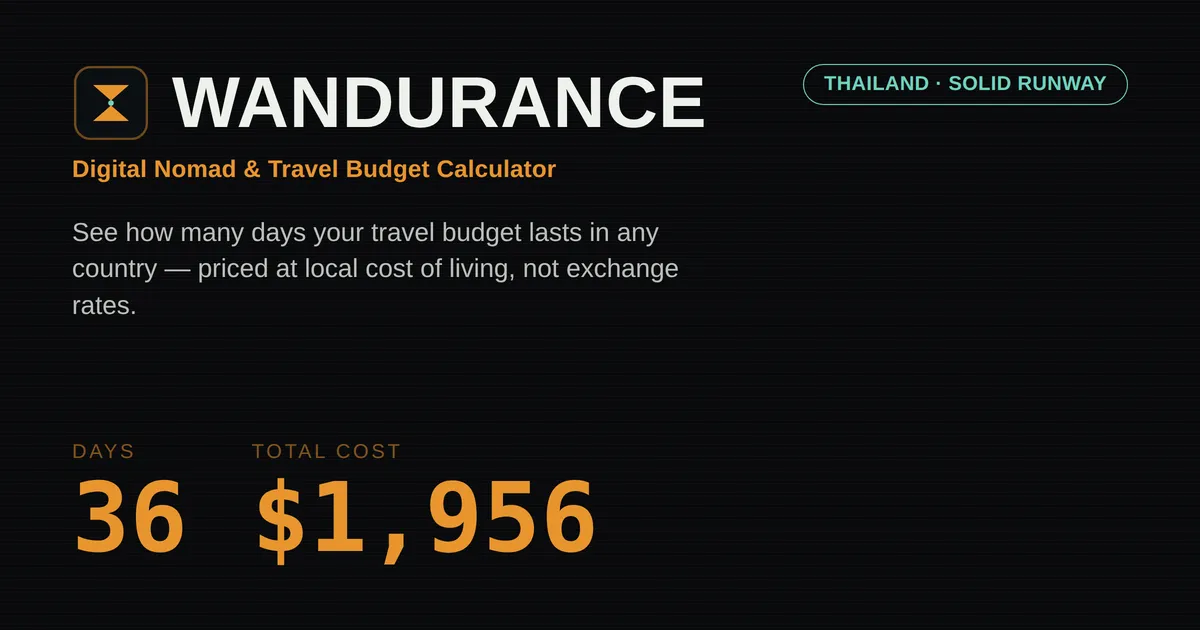
Wandurance is a free, browser-based budget calculator built for digital nomads, backpackers, and long-term travelers. Rather than relying on currency exchange rates, it uses purchasing-power-parity (PPP) pricing to estimate daily costs in any country based on local price levels. The tool answers a fundamental planning question: how many days will a fixed travel budget actually last? With options for lifestyle tiers, city cost adjustments, and a multi-stop trip planner, Wandurance goes beyond a simple calculator to become a practical travel-planning companion.
Key Features
Wandurance packs a surprising number of planning tools into a clean, single-page interface. The result board uses a departure-board styling with large, tabular numbers and a status pill that indicates whether the budget is likely to last for a short, moderate, or long period. The features include:
- PPP-based cost modeling: Instead of showing a simple exchange rate, the app estimates daily costs by scaling four baseline spending categories — accommodation, food, local transport, and a basic medical buffer — to each country's price-level index. This gives a more realistic picture of what a dollar will buy on the ground. The PPP approach is the core differentiator, as explained in the methodology section.
- Three lifestyle tiers: Users can switch between Frugal, Normal, and Lavish presets. Frugal assumes hostels and street food, Normal uses guesthouses and sit-down meals, and Lavish covers hotels, restaurants, and taxis. The daily cost adjusts instantly, with each tier providing a distinct set of sub-parameters.
- City cost-level adjustment: Since national price indices are averages, Wandurance adds a coarse capital/hub city versus smaller city/town toggle to nudge the estimate up or down, reflecting that nomads often cluster in pricier urban areas. This is a rough adjustment, not per-city data, but it's a thoughtful middle ground.
- Optional coworking & connectivity add-on: A toggle adds a rough daily allowance for a coworking desk and local SIM/data plan. This is especially relevant for remote workers who need reliable internet and a place to work beyond their accommodation.
- Manual overrides via advanced settings: Under the Adjust daily costs panel, users can directly edit the daily amount for accommodation, food, local transport, medical, and (when enabled) connectivity. This is helpful for travelers who already know local prices from previous trips or research. The fields reset to defaults when changing destination or lifestyle.
- Destination comparison tool: Add multiple countries to compare estimated daily cost and total runway side-by-side. This is ideal for evaluating several potential bases at once, without opening multiple tabs.
- Multi-stop trip planner: A separate planning section allows stacking destinations in order, setting a day count for each, and seeing whether the combined itinerary fits within a single budget. The planner shows a running total, highlights whether the sum is over or under budget, and updates as stops are added or edited.
- Shareable links and print/PDF: The result board includes a Copy shareable link button that encodes the current budget, destination, lifestyle, city tier, connectivity toggle, and any manual overrides into the URL. The Print / save as PDF option removes non-essential UI elements for a clean output.
- Fully client-side architecture: The app runs entirely in the browser — no backend, no account, no tracking, no cookies. Once loaded, it works offline, which is a significant advantage for travelers with unreliable connectivity.
- Built-in reference data: The homepage includes a budget-friendly destinations table with estimated daily costs and approximate days on a $3,000 budget for popular countries like India, Thailand, and Portugal. The FAQ section explains the methodology and limitations in plain language.
How It Works
The workflow is straightforward and requires no sign-up. The user enters a total travel budget in US dollars, searches for a destination from a database of 190+ countries using the combobox, and picks a lifestyle tier (Frugal, Normal, or Lavish). The calculator immediately displays two headline numbers: the number of days the budget will last and the total cost for that period. Beneath the board, a daily cost breakdown shows the estimated allocation across accommodation, food, transport, medical, and (if enabled) coworking/connectivity, visualized as a horizontal bar and a list of categories with dollar values.
The PPP logic begins with four baseline daily costs for a US traveler — accommodation, food, local transportation, and a small basic-medical-care reserve — for each lifestyle tier. Each destination is assigned a relative price-level index based on World Bank data, and the baseline costs are scaled by that index before being converted back into dollars. For example, a country with a price level of 50 means that a dollar effectively buys twice as much as in the US, so the daily cost for a Normal traveler might drop from $70 to $35. The city cost level nudges the index up or down, and the connectivity add-on is a separate flat daily allowance.
Advanced settings allow users to bypass the automatic estimates and enter custom daily amounts for each category. Switching destination or lifestyle resets the fields to defaults, and the interface provides a Reset to defaults button. Every change recalculates instantly without a page reload, thanks to the client-side architecture.
The shareable link uses URL parameters to restore the exact state, making it easy to share a specific result or save it for later. The print-friendly layout strips out interactive elements when exporting to PDF. The app also includes a frequently asked questions section that answers common questions about accuracy, visas, and the difference between PPP and exchange rates.
One notable aspect is the transparency: the methodology is explained in a collapsible Read the full methodology section, and the FAQ acknowledges that estimates are planning-grade, not live prices. This honesty sets clear expectations for users.
Use Cases
Wandurance serves three primary audiences, all of whom benefit from seeing a realistic runway number based on local purchasing power.
Digital nomads planning their runway. Remote workers can compare how many working-free days a fixed pot of money buys in different hubs using the comparison tool. For example, a budget of $3,000 might last around 55 days in Thailand at a Normal lifestyle, versus 42 days in Portugal. The optional coworking/connectivity add-on helps estimate the true daily overhead, which is easy to forget when budgeting from a national average.
Backpackers and gap-year travelers. For those with a fixed pot of savings and a multi-country route, the Frugal tier replicates a hostel-and-street-food budget. Users can stack each planned stop in the multi-stop planner, set the days per stop, and instantly see whether the total route fits within their bank balance. This prevents the common mistake of over-budgeting for the first leg and running out of money midway through the trip.
Expats, slow travelers, and remote retirees. For longer stays, small daily differences compound into significant amounts. The daily cost breakdown and the basic-medical buffer help sanity-check a monthly budget before signing a lease or applying for a long-stay visa. The ability to manually adjust costs is particularly useful for people who already have a good sense of their spending patterns.
The tool is equally useful for quick, single-destination checks. A user planning a two-week vacation can enter their savings, pick a country, and see a rough ceiling on how long they can stay without working. The departure-board-style result is intuitive enough to share with a travel buddy.
Pricing & Value
Wandurance is completely free to use. There are no paid tiers, premium features, or subscription plans; every function — the calculator, comparison tool, multi-stop planner, shareable links, and offline support — is available without restriction or registration. The site explicitly states that it sets no cookies, runs no analytics or trackers, and makes only one outside request to Google Fonts for typography. This makes it a privacy-friendly option for travelers who prefer not to create accounts or share data.
For a free tool, the value is substantial. The PPP-based approach is more informative than a basic currency converter, and the multi-stop planner is a feature typically found in paid travel-planning services. The lack of live price data means users should still verify accommodation and transport costs with booking sites before committing, but as a first-pass planning aid, it's hard to beat the price.
Final Verdict
Wandurance successfully fills a specific niche: it's a fast, free, and privacy-respecting budget calculator that gives travelers a realistic answer to how long will my money last? The use of purchasing power parity rather than exchange rates is a genuine differentiator, and the inclusion of lifestyle tiers, city cost adjustments, and a multi-stop planner shows a clear understanding of how travelers actually think about budgets. The client-side architecture is a bonus for anyone who will be in places with unreliable internet.
The main trade-off is accuracy. The estimates are based on general cost-of-living patterns, not live prices, so they should be treated as a ballpark rather than a definitive quote. Users who already know specific costs can override the defaults, which mitigates some of the problem. Another limitation is that the tool doesn't factor in flights, visas, or travel insurance, but that's clearly communicated.
Overall, Wandurance is a recommended addition to any traveler's planning toolkit. It's particularly valuable for digital nomads narrowing down a list of possible bases, and for backpackers who need to check whether their savings will carry them through a multi-country route. Given the free price tag and offline capabilities, there's very little reason not to try it.