
Introduction
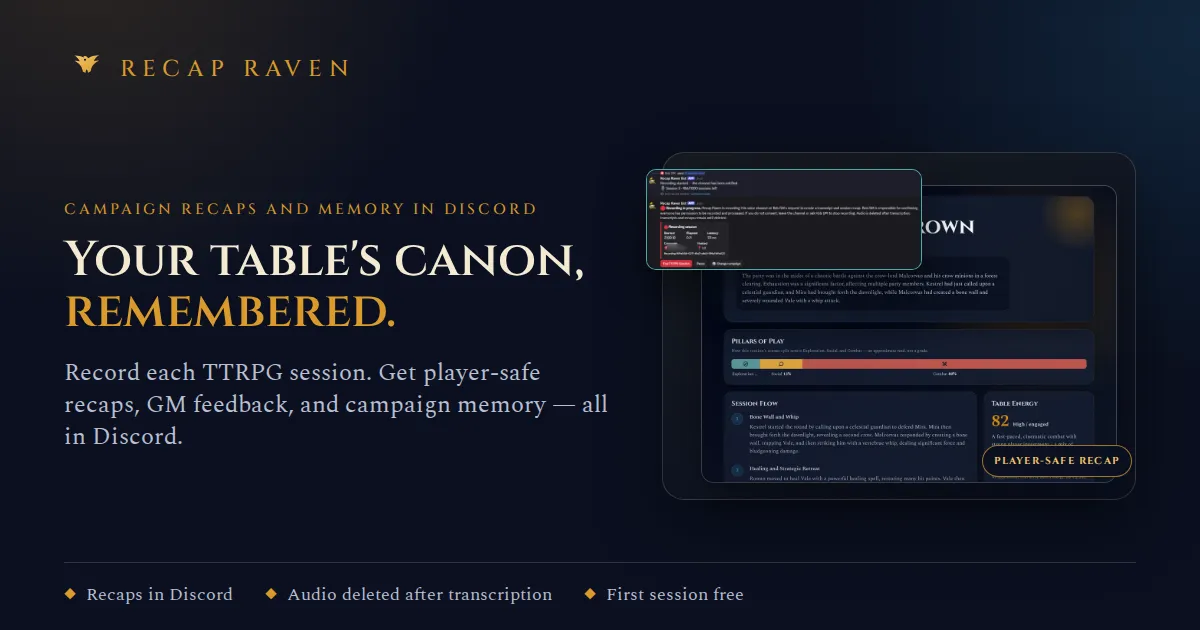
Recap Raven is a Discord-native artificial intelligence bot built for tabletop role-playing game communities, particularly Dungeons & Dragons groups that run sessions over voice channels. It records the conversation, transcribes it, and turns the raw audio into structured outputs: a player-safe recap, private game-master notes, session analytics, and a persistent campaign memory that can be queried with natural language. The core value proposition is context retention — players who return weeks later can ask 'Where was Sol’Thun’s soul stored?' and get an answer tied directly to the session transcript. This review examines how the product works, where it fits into a table’s workflow, and whether the paid tiers justify the cost.
Key Features
The feature set combines audio capture, AI text generation, and knowledge management. The tool is not merely a speech-to-text recorder; it applies semantic understanding to the table's conversation, distinguishing between player dialogue, GM descriptions, and out-of-character chatter. This distinction is what enables the player-safe filter.
Voice Recording and Consent
The bot lives entirely inside Discord. A server admin uses an OAuth flow to invite the bot and grant access to voice channels and message posting. The bot announces when it starts recording, shows a visible recording status, and supports pause and stop. Crucially, raw audio files are deleted within minutes after transcription, not stored indefinitely. The transcript maps speech to character names based on Discord user identities, which gives an accurate per-speaker breakdown.
Player-Safe Recaps
After processing, the bot writes a narrative recap intended for the players. It deliberately strips out GM-only information: any speculation, private prep, or notes flagged as GM-only are excluded. The recap is posted into a chosen Discord channel automatically. The GM can adjust it before sharing if needed. The bot also maintains a separate 'private transcript' for each player showing only what their character could have heard.
Source-Backed Campaign Memory
The campaign memory is not a static wiki; it is a continuously updated knowledge graph of people, places, items, and events. Users can ask natural language questions in Discord, and the bot responds with a concise answer plus a quoted excerpt from the session transcript as evidence. Citations include session number and speaker, making verification trivial. This feature bridges the gap between raw logs and prepped lore. If the database lacks evidence, the bot is designed to say so rather than guess, which builds long-term trust.
GM Analytics and Review
The private GM report includes:
- A session score (0-100) summarizing overall table engagement
- Words spoken per participant to spot over- or under-contributing players
- Spotlight balance showing which players dominated attention
- Table energy over time, plotted against session beats
- A breakdown of pillars of play: exploration, social, combat percentages
- GM review notes containing coaching suggestions and topics the table kept returning to
This data can be used to identify pacing issues that players might not mention verbally.
Hooks, Threads, and Preview
The bot tracks 'open story hooks' — unresolved promises, mysteries, threats, and quests. It displays which session introduced a hook and when it last changed, and it flags potential resolutions. The next-session prep feature generates a list of likely directions based on recent player behavior and open threads, so the GM can prepare ahead without guesswork.
Campaign World Wiki
Included in memory plans, this wiki is populated automatically from the transcript. Each entry (character, location, item) links back to the moments where it was mentioned or used. GMs can add aliases, private notes, and correct data. The player-visible portion only shows canonical information; private GM annotations stay behind a permission boundary. The dashboard also allows users to correct entities, merge duplicates, and adjust aliases, which directly improves future Ask results.
Language Support
Processing works for English, Italian, Spanish, French, German, and Brazilian Portuguese. This makes the tool viable for many international communities and is a standout feature compared to competitors that only handle English.
Privacy and Data Controls
The platform states it does not use session content for training AI models, and account deletion exports all retained data. Transcripts, recaps, and the wiki can be exported or erased at any time. An analytics notice on the site offers opt-out for privacy-friendly, cookieless analytics. The privacy policy details how raw audio is handled after transcription.
Extensibility
The footer mentions an MCP server (Model Context Protocol), which suggests the campaign knowledge base can be exposed to external AI tools. There is also a 'Bring your own AI' page, hinting that experienced users can integrate their own model endpoints. That level of customization is unusual for a consumer-focused bot. More technical details are available in the how-it-works documentation.
How It Works
The setup process is intentionally lightweight. A server owner clicks the Discord OAuth link on the homepage, selects a server, and authorizes the bot's permission set. From there, the web dashboard guides the user through creating a campaign and optionally setting up a preferred language. The bot displays a 'record' state in the channel and announces in text when recording begins.
During play, the bot continuously captures audio from all users in the voice channel. It does not require any users to run a local client; the bot handles everything server-side. If the GM needs to pause for a sidebar conversation or a sensitive discussion, they can issue a pause command. The recording also stops automatically after a defined period of inactivity.
Once the session concludes, the bot processes the audio. The processing time is typically under ten minutes, but can extend for longer sessions. The transcript is generated and mapped to user identifiers; the game-ready recap, player messages, GM analytics, and memory updates are produced in a single pipeline. The GM can review the outputs in the web dashboard, edit recaps, and correct transcript errors if needed. Errors are unlikely to cascade because the memory engine reads from the transcript text, not from raw speech.
The Ask interaction works directly in Discord: a user types a question, and the bot searches the campaign memory, retrieves relevant passages, and returns a verdict with a quote. If there is insufficient evidence, the bot is expected to say so rather than speculate. This behavior helps maintain trust and reduces hallucinated lore.
Use Cases
-
Weekly D&D campaigns: For groups that meet over Discord and struggle with note-taking, Recap Raven acts as an immutable session log. The GM can offload recap writing, track attendance, and reference lore without flipping through old notes.
-
Long-running story arcs: Campaigns that pause for weeks or months benefit most. Players can catch up on highlights, and the campaign memory lets them ask questions like 'Who did the ghost possessing Vorlen give the Widow’s Compass to?' The answer is pulled from the actual session, not from the GM's memory.
-
New or busy Dungeon Masters: The GM analytics and next-session prep reduce the time spent reviewing previous sessions. The bot identifies which player was in the spotlight, which scenes had low energy, and what threads are still open, making it easier to adjust pacing.
-
Player engagement and trust: Since recaps are player-safe and source-cited, the system builds trust that GM secrets remain hidden. The consent-first recording approach is ideal for players who are wary of being recorded without their knowledge.
-
Multilingual tables: Groups that play in Italian, Spanish, French, German, or Portuguese can use the bot in their native language, and the recaps and campaign memory are generated in that language as well.
-
Community moderation and campaign management: The wiki can be used as a shared reference for players, reducing repetitive questions about NPC names and plot points. The hooks list helps GMs keep side quests alive without maintaining a separate spreadsheet.
-
Solo or small groups with one GM: Even a casual group that plays monthly can benefit from the free first session to evaluate the product's accuracy and fit.
Pricing & Value
The pricing page clearly lays out three tiers. The free tier covers one complete recorded session in one campaign, which acts as a no-card-required trial. It includes transcription, player-safe recap, GM notes, analytics, and a first-session trial of campaign memory.
The 'Recap Only' plan costs $7.99 per month and includes five sessions across up to five campaigns. It is designed for a weekly game, with room for fifth Tuesdays. This plan does not include the campaign memory ask feature, which is a significant limitation for players who want the full knowledge base.
'Campaign Memory' starts at $11.99 per month and scales from five to twenty sessions per month, with ten to fifty campaigns. This is the only tier that provides the cross-session campaign memory and Ask feature, plus campaign-wide analytics. For a GM running a serious multi-year campaign, the $11.99 tier delivers a meaningful productivity gain if the tool replaces manual note-taking and prep time.
There is no annual pricing mentioned; the subscription is monthly. The value proposition is straightforward: a night of prep time saved justifies the cost for many GMs. The free trial allows thorough testing before committing.
Final Verdict
Recap Raven is one of the more well-designed AI note-taking tools for tabletop RPGs. It solves a real pain point—session continuity—by combining high-quality transcription, grounded AI generation, and a privacy model that respects player consent. The source-backed answers are a differentiator; many AI assistants hallucinate, but this one provides receipts from the transcript.
The main trade-offs are platform dependency (Discord voice only), the processing delay, and the clear paywall around campaign memory. The free tier is enough to evaluate the bot, but the basic paid plan feels incomplete without the memory engine. Still, for a weekly group that has wrestled with 'what happened last session,' the $11.99 per month price is reasonable. The how-it-works documentation and the privacy policy are refreshingly transparent about data retention and consent. Recap Raven is worth a test run, especially for GMs who want to shift effort from administrative work to actual storytelling.